By Jeffrey A. Roberts
CFOIC Executive Director
Efforts to weaken the Colorado Open Records Act and give an open meetings law exemption to the state Public Utilities Commission fell short during the 2026 session of the General Assembly, which ended Wednesday.
State lawmakers also restored access to funeral home inspection reports, addressed the opaqueness of municipal courts and reinforced a requirement that all criminal court proceedings be livestreamed. But they rejected an attempt to increase the transparency of their own legislative caucuses and watered down a bill intended to make sure parolee assessment records remain open for inspection.
The session began in mid-January with a different look for the public. For the first time, anyone tuning in to legislative committee hearings online could see — not just hear — the meetings. The Colorado Freedom of Information Coalition and the chair of the Colorado Channel Authority Board had pushed legislative leaders to turn on the cameras in the committee rooms after CFOIC research showed that Colorado was the only state not to provide at least some video coverage of legislative committee meetings.

Senate Bill 26-107, the CORA measure that died in a Senate committee in March, was Sen. Cathy Kipp’s third consecutive try at giving state and local government entities up to three weeks to fulfill many records requests. The Fort Collins Democrat called her measure “balanced” and said it was “not an attack on open records. It is an attempt to make the system work better for everyone.”
But CFOIC argued that CORA requesters should not face additional barriers to obtaining public records when they frequently deal with delays, exorbitant fees and misapplied exemptions in the law. There is no need for the bill, we said, because not a single court has held a custodian of CORA records liable for not complying with the response deadline.
Sen. Katie Wallace, a Longmont Democrat, was the deciding no vote in the Senate State, Veterans & Military Affairs Committee. “I believe that the government should provide transparency and accountability every chance it gets to its people,” she said. “When governments start hiding or even appearing to hide, it’s a bad thing for representative democracy.”
The sponsors of a successful bill to reauthorize the PUC, House Bill 26-1326, agreed to remove a provision that would have let the three commissioners engage in “nonpublic” discussions after hearing evidence on adjudicatory matters. The Colorado Office of Policy, Research & Regulatory Reform had recommended the Colorado Open Meetings Law exemption in a sunset review report last fall, arguing that compliance with the COML “stymies brainstorming” and may also “inhibit the efficiency” of drafting decisions.
But groups including CFOIC emphasized the public’s strong interest in knowing how the PUC makes decisions on vital energy policies that impact all Coloradans.
“Although evidence in commission proceedings is developed during formal hearings, the most critical phase of PUC work occurs when commissioners deliberate about how that evidence should be interpreted and applied,” CFOIC told members of the House Energy and Environment Committee in testimony. “Observing that process allows the public to see how complex technical evidence is evaluated and how PUC commissioners weigh tradeoffs among affordability, reliability, and long-term planning.”
Here is a roundup of other 2026 government transparency, freedom-of-information, First Amendment and press-related measures tracked by CFOIC:
Courts transparency. House Bill 26-1134, signed into law by Gov. Jared Polis in late April, enhances transparency requirements for municipal courts and reinforces livestreaming mandates for all criminal courts in Colorado. The bill prohibits municipal courts that don’t document their proceedings from sending people to jail. It also clarifies that defendants in municipal courts have a right to counsel, proceedings must be “accessible to any member of the public for public observation” and livestreamed proceedings are required when a defendant is charged with a municipal violation that could involve jail time.
For all criminal courts, HB 26-1134 says that livestreaming requirements in a 2023 law “supersede any statute, judicial guidance, or chief justice directive limiting remote public observation.” The Denver Post reported in 2025 that some judges still weren’t allowing livestreams of their courtrooms, despite the statutory requirement.
Funeral home inspections. In 2024, when lawmakers tightened regulations on the funeral home industry in response to misconduct at several mortuaries, they also deleted a statutory provision that opened records of facility registrations and disciplinary proceedings.
House Bill 26-1258, which passed earlier this week, restores some public access, making reports of annual funeral home inspections subject to CORA, “excluding photographs and audio and video recordings and any information that would personally identify a deceased individual.”
Another measure signed into law by Polis in early May, Senate Bill 26-105, requires county coroners to disclose online any financial interests they have in funeral homes or other death-care businesses. The now-former Pueblo County coroner was a co-owner of Davis Mortuary in Pueblo, where 20 decomposing bodies were found behind a hidden door.
Parolee assessments. House Bill 26-1315 was supposed to make sure the public regains access to records used by 9NEWS to show errors in the way the state screens the risk levels of parolees. The Colorado Department of Corrections stopped providing the risk-assessment documents to the news organization in January, citing “copyright protections” as the reason.
Although the measure passed earlier this week, the Senate “watered down the bill,” according to Rep. Matt Soper, the Delta Republican who introduced it. The bill now requires the disclosure of “risk assessment outputs,” described as “the total score and resulting parole supervision level,” rather than the entirety of the documents.
“Without access to the full scores, the public and press will not be able to identify the very same errors our investigation discovered,” 9NEWS investigative reporter Chris Vanderveen told CFOIC. “This law allows the public to see the actual grades but prohibits us from better understanding why.”
Legislative caucus transparency. Two bills were introduced in the wake of a controversial Vail retreat last fall by moderate Democratic members of the legislature. Neither passed.
Senate Bill 26-168, sponsored by Democratic Sen. Mike Weissman of Aurora, would have required all legislative caucuses to disclose their fundraising and spending. It defined a legislative caucus to be two or more legislators “who organize themselves according to a common interest, ideology, issue, identity, or for any other reason.” An earlier version introduced by Weissman, Senate Bill 26-108, addressed spending and revenue of legislative groups, defined as caucuses, committees, clubs or organizations that involve at least one legislative member.
The Independent Ethics Commission is investigating whether lawmakers who attended the Opportunity Caucus retreat in Vail violated the state’s gift ban. A lawsuit accuses two legislators who lead the Opportunity Caucus of violating CORA by failing to turn over records about the retreat.
Bodycam footage. Senate Bill 26-190, which passed the legislature on Wednesday, rewrites portions of the Law Enforcement Integrity Act and other statutes to make sure family members of people killed by police get quicker access to body-worn and dashboard camera footage.
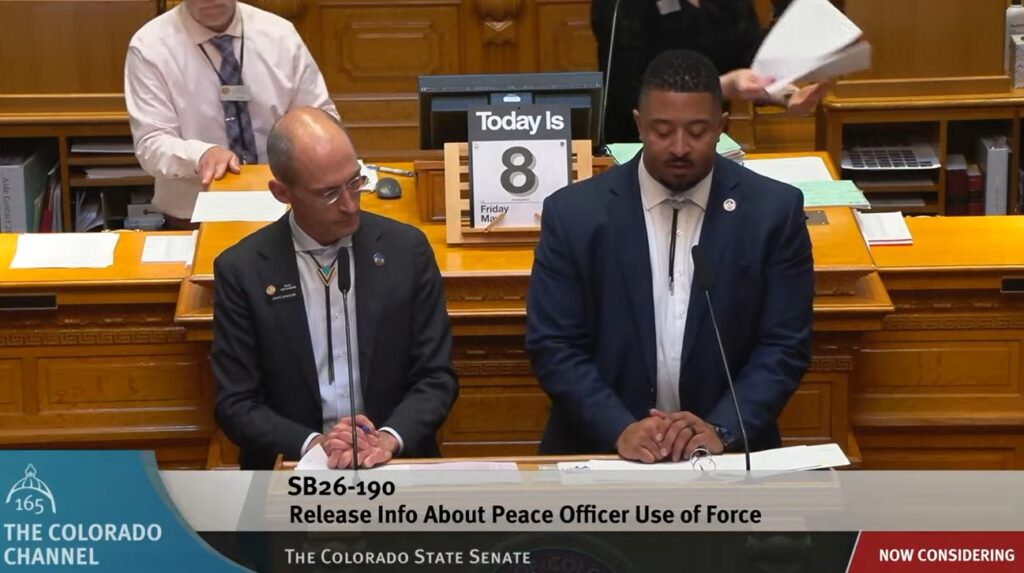
When an officer’s use of force results in a death, an agency will be required to provide to the person’s immediate family — unless they decline — “all video and audio recordings depicting the decedent’s death” within 21 days after the incident. Unlike current law, no complaint of peace officer misconduct will be necessary for family members to get footage depicting a use-of-force death. But a complaint of misconduct still is required for journalists and the public to obtain unedited video and audio after the 21-day period expires.
Redacting personal information. House Bill 26-1422, which also passed on Wednesday, adds state lawmakers and many other government officials in Colorado to the list of “protected persons” who, for safety reasons, can get their home addresses and other personal information removed from public records posted on the internet.
Officials who ask for the redactions must affirm in writing a “reason to believe that the dissemination of the personal information … poses an imminent and serious threat” to their safety. The bill also requires the Colorado Secretary of State’s office to redact a candidate’s address and other personal information from disclosure statements before publishing them on its TRACER website. And it removes a requirement that financial disclosures filed by certain public officials include the legal description of any real property they own, instead letting them write down only the city and county in which the property is located.
Municipal jails. House Bill 26-1039, signed into law by Polis in late April, requires municipal jails to maintain and make available to the public a daily record of inmates like county jails must do. The measure primarily affects the Aurora Detention Center, also mandating that it comply with uniform statewide jail standards adopted by a commission created in 2022.
“Jails should not become black holes where no one knows who is held there or what charges they’re held on,” Dana Steiner, policy counsel for the Colorado Freedom Fund, said in a committee hearing. “Transparency is a tool for accountability. HB 26-1039 recognizes that wherever someone is detained in Colorado, transparency is called for.”
A boost for local news. A footnote in the state budget bill signed by Polis last week directs state agencies with appropriations for marketing, advertising or public outreach to develop plans that prioritize “expending the appropriated money with Colorado-based members of the media.” The plans should include “specific strategies for prioritizing print, broadcast, and digital news organizations primarily serving Colorado’s local communities.”
“A real win for local news in Colorado, and an important first step in building the state’s support for informed communities,” wrote Colorado Press Association CEO Tim Regan-Porter in a LinkedIn post.
Flock cameras. Pushback from law enforcement agencies forced the sponsors of Senate Bill 26-070 to abandon their effort to regulate how data from automated license plate readers is used. Before the bill died on the Senate calendar, CFOIC persuaded the sponsor to remove language that could have been used to deny access to other types of records that contain information about an individual’s location.
An oath to testify. A House committee in February killed House Bill 26-1149, which would have required people testifying before legislative committees to swear an oath to tell the truth under penalty of perjury. Sponsoring Rep. Ty Winter, R-Trinidad, described it as “a good governance bill” that would hold people accountable for spreading misinformation at the state Capitol. “I want people to come in and tell us the truth,” he said.
State government lobbyists. The Denver Post reported this week that Polis likely will veto Senate Bill 26-147, which requires state employees who work as lobbyists for the governor and lieutenant governor to disclose their positions on bills with the Secretary of State, as private lobbyists must do. The bill “was born out of frustration, a universal experience among most of us,” sponsoring Rep. Meg Froelich, D-Englewood, told the newspaper.
Follow the Colorado Freedom of Information Coalition on X and Bluesky. Like CFOIC’s Facebook page. Do you appreciate the information and resources provided by CFOIC? Please consider making a tax-deductible donation.