By Jeffrey A. Roberts
CFOIC Executive Director
Sponsors of a bill to reauthorize the Colorado Public Utilities Commission agreed Thursday to remove a provision that would have let the three commissioners engage in “nonpublic” discussions after hearing evidence on adjudicatory matters.
The Colorado Office of Policy, Research & Regulatory Reform recommended the Colorado Open Meetings Law exemption in a sunset review report last fall, arguing that compliance with the COML “stymies brainstorming” and may also “inhibit the efficiency” of drafting decisions.
But groups including the Colorado Freedom of Information Coalition, the Colorado Press Association and the Independence Institute emphasized the public’s strong interest in knowing how the PUC makes decisions on vital energy policies that impact all Coloradans.
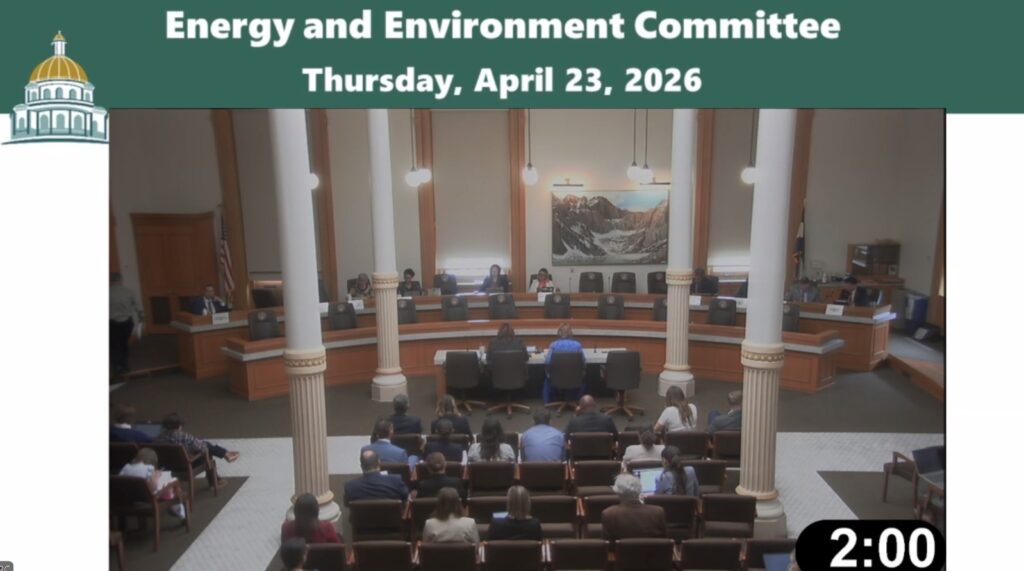
“Although evidence in commission proceedings is developed during formal hearings, the most critical phase of PUC work occurs when commissioners deliberate about how that evidence should be interpreted and applied,” CFOIC told members of the House Energy and Environment Committee in testimony. “Observing that process allows the public to see how complex technical evidence is evaluated and how PUC commissioners weigh tradeoffs among affordability, reliability, and long-term planning.”
Because the PUC is a state public body, a meeting of two of the three members concerning public business is subject to the requirements of the open meetings law. Ever since voter approval of the Colorado Sunshine Act of 1972, such discussions have been “declared to be public meetings open to the public at all times.”
“Full and timely” notice to the public is required for meetings at which the adoption of a policy or position occurs or at which a majority or quorum of the body attends or is expected to attend. Minutes must be “taken and promptly recorded.”
During the sunset review process, “multiple stakeholders expressed frustration at the length of time it can take the Commission to make a decision on certain matters,” the Office of Policy, Research & Regulatory Reform report said. “Some of this may be, at least in part, attributable to the Open Meetings Law requiring that substantive discussions among Commissioners about matters for decision be conducted only in open public meetings.”
As introduced by Rep. Jenny Willford, D-Northglenn, and House Majority Leader Monica Duran, D-Wheat Ridge, House Bill 26-1326 would have allowed “nonpublic predeliberation” discussions among all three commissioners “after the close of the evidentiary record for an adjudicatory matter” if notice was first provided to the public and the “final reasoning and any determinations of the discussion, including any dissenting opinions, are summarized in a subsequent public hearing.”
Willford said many organizations, including “utilities, the press as well as environmental organizations,” asked for the open meetings exemption to be removed. Doing so, she added, preserves “the current requirement that all commissioner deliberations occur in public and on the record.”
The press association requested an additional amendment, supported by CFOIC, that would make sure utility customers are clearly notified of rate increases. Press association CEO Tim Regan-Porter pointed out recent Xcel Energy ads that “used language like ‘new rates to better serve you’ without telling customers that their rates were going up, by how much and what to do about it. To find that information, customers had to click through multiple layers to get to a page on the utility’s own website.”
CPA’s proposed amendment would clarify that any alternative form of notice “must include and present the information that the law already requires — clearly, directly and in a form that is fixed, accessible and not controlled by the entity giving the notice.”
The energy and environment committee did not consider that amendment Thursday, but it could be taken up as the bill advances in the legislature. The committee passed HB 26-1326 to the House Finance Committee on a 9-4 vote.
Follow the Colorado Freedom of Information Coalition on X and Bluesky. Like CFOIC’s Facebook page. Do you appreciate the information and resources provided by CFOIC? Please consider making a tax-deductible donation.