Update: Gov. Jared Polis signed SB 26-190 into law on Wednesday, June 3.
By Jeffrey A. Roberts
CFOIC Executive Director
State lawmakers are rewriting portions of Colorado’s Law Enforcement Integrity Act and other statutes to ensure that family members of people killed by police get quicker access to body-worn and dashboard camera footage and additional information.
Following the killings of George Floyd in Minneapolis and Elijah McClain in Aurora, the legislature in 2020 and 2021 established a timetable for the public release of bodycam and dashcam video of incidents “in which there is a complaint of peace officer misconduct.”
But the families of Kilyn Lewis, Jalin Seabron and others who have died during encounters with law enforcement say they’ve nonetheless had trouble getting timely details and records from authorities.
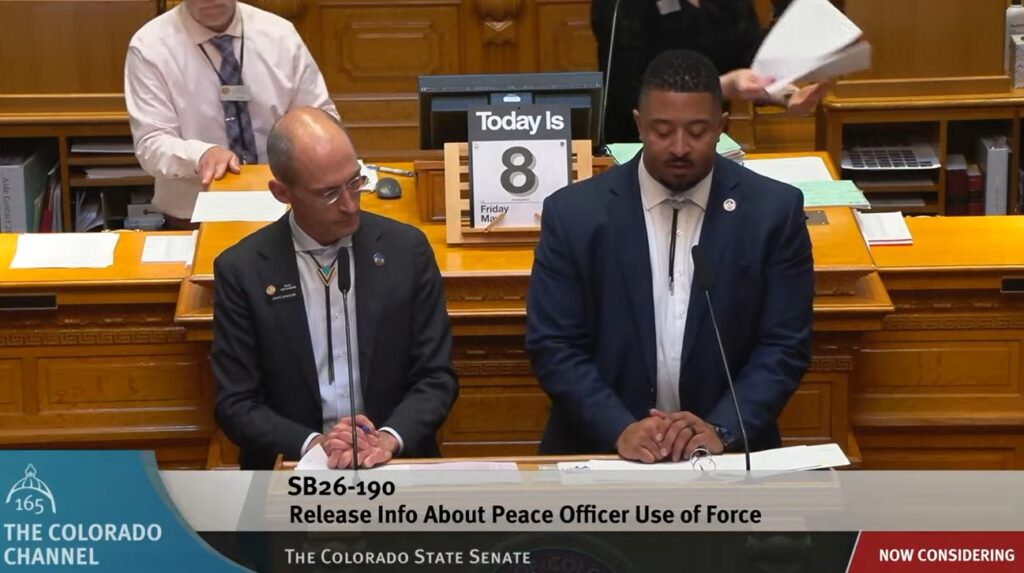
“This is not about rushing investigations. It is about preventing indefinite delay,” said Senate President James Coleman, D-Denver, who introduced Senate Bill 26-190 earlier this week with Sen. Mike Weissman, D-Aurora. “It ensures that access to critical information is not dependent on discretion, but instead follows a predictable, transparent process.”
Under amendments adopted on the Senate floor, when an officer’s use of force results in a death, an agency would be required to provide to the person’s immediate family — unless they decline — “all video and audio recordings depicting the decedent’s death” within 21 days after the incident. Unlike current law, no complaint of peace officer misconduct would be necessary for family members to quickly get access to footage depicting a use-of-force death.
But a complaint of misconduct still would be required for journalists and the public to obtain the unedited video and audio after the 21-day period expires. A misconduct complaint also would be necessary to obtain footage of an incident “that does not result in a victim’s death.” When there is a complaint in such cases, the Law Enforcement Integrity Act says that video should be provided no later than 21 days after a request is made.
As discussed by the Colorado Freedom of Information Coalition in a 2023 blog post, some journalists have been denied footage of officers shooting and killing someone because no one had filed a formal complaint. Law enforcement agencies instead treated those requests under the Colorado Criminal Justice Records Act, rather than the Law Enforcement Integrity Act, deciding that disclosure would be “contrary to the public interest.”
CFOIC has argued that there should be no complaint requirement for the public disclosure of footage depicting a use-of-force death. It was not in the version passed by the Senate State, Veterans and Military Affairs Committee on Tuesday, but was added on the Senate floor Friday.
The bill also requires agencies to notify immediate family members, within 24 hours, about other agencies involved in reviewing a use-of-force death as well as the status of the investigation.
During the state affairs committee hearing, lawmakers heard testimony from relatives of Kilyn Lewis and Jalin Seabron. A Douglas County sheriff’s deputy shot and killed Seabron at a Highlands Ranch arcade bar in 2025. An Aurora SWAT officer shot and killed Lewis, who was unarmed, in 2024.
LaRonda Jones, Lewis’ mother, told lawmakers she was not notified within 24 hours — “It was way after that.” When police released only portions of the bodycam video, she said, “they coerced the minds of the people in the public by showing them the edited version.” And despite a successful lawsuit by 9NEWS, the department still hasn’t released all unedited footage of the incident, she added.
“They’re still showing the edited version,” Jones said. “We as a family really want to know what happened within that time period when my son’s life was taken.”
Veronica Seabron, Jalin’s mother, said her son was “labeled as the shooter” during an active-shooter incident at the bar “and a correction was never aired, creating hate mail and trauma that will last for generations.” The bill “is a step toward clarity, structure and truth when families need it most.”
SB 26-190 also would prohibit law enforcement officers who participate in use-of-force fatality investigations from making extrajudicial statements that they reasonably know “will have a substantial likelihood of materially prejudicing an adjudicative proceeding in the matter.”
It says that law enforcement videos produced for community briefings must include disclaimers “indicating that the recording has been modified from its original form.” Any narration or text “must be limited to the facts of the incident known at the time of the recording and must not include editorial commentary that is opinion or that provides a legal conclusion as to criminality, liability, or misconduct.”
“There should be some sideboards on statements that are made in the immediate aftermath (of fatal police shootings) in terms of shaping public perceptions or narratives,” Weissman said during the Senate floor discussion.
Follow the Colorado Freedom of Information Coalition on X and Bluesky. Like CFOIC’s Facebook page. Do you appreciate the information and resources provided by CFOIC? Please consider making a tax-deductible donation.