By Jeffrey A. Roberts
CFOIC Executive Director
A case in the Court of Appeals about the redaction of public records “presents a simple but monumental question for the future of government transparency in Colorado,” the Colorado Freedom of Information Coalition says in an amicus brief.
“If a portion of a public record contains confidential information, may the custodian of that record withhold the entire document rather than producing a redacted version upon request?”
“The answer is unequivocally no,” CFOIC told the appellate court, asking it to reverse a January ruling by Larimer County District Court Judge Gregory Lammons. The public hospital district in Estes Park, the judge decided, is not required to redact privileged material from attorney billing invoices and release non-confidential portions to the Estes Valley Voice.
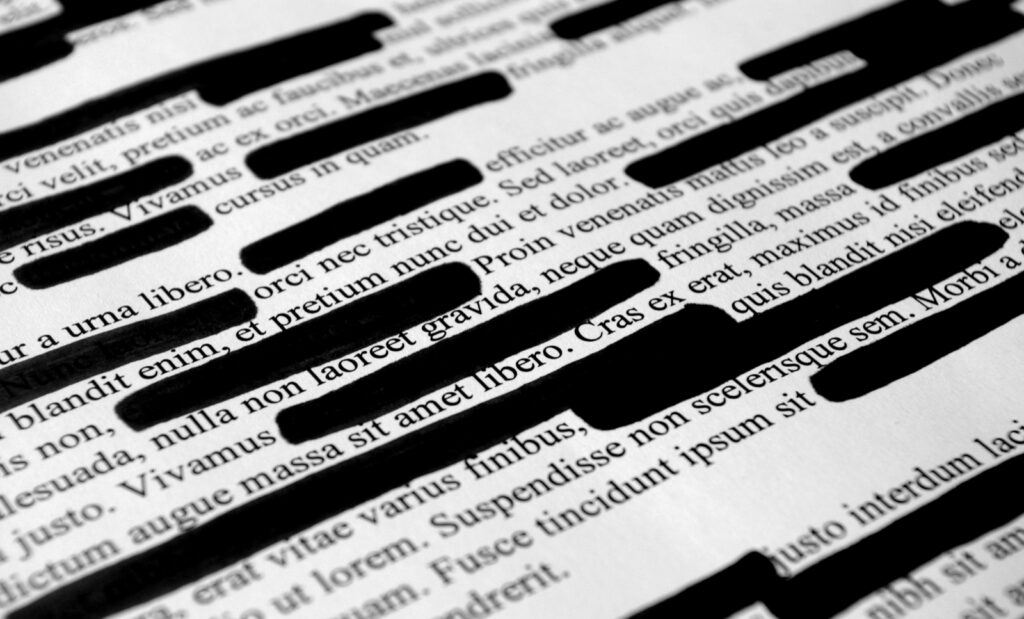
The Colorado Open Records Act (CORA) “does not contain a duty to redact,” Lammons wrote, siding with Estes Park Health’s position that “redaction is a permissible but optional approach.”
But the judge’s decision is contrary to language in CORA that makes clear a custodian “shall allow any person the right of inspection of … records or any portion thereof,” except under provisions in the statute limiting disclosure, argues the brief CFOIC submitted on Friday. If records custodians have no “duty to redact” under CORA, it warns, “the public will be routinely kept in the dark about government conduct of legitimate public concern.”
A separate brief filed on the Voice’s behalf by attorneys Michael Beylkin and Steve Zansberg (CFOIC’s president) says that Lammons’ ruling “converts the CORA’s narrowly crafted exception for attorney-client privilege information into a license to withhold the entirety of public records no matter how minimal may be the amount of actually privileged information in each document.”
“By finding that CORA does not require a custodian to redact isolated excepted content, thereby allowing a public hospital district to withhold the entirety of voluminous public records (some 323 pages), the District Court eviscerated the statute’s presumption in favor of public disclosure, and carved a gaping loophole into CORA’s disclosure requirements,” it says.
Prepared by attorneys Madison Schaefer, a CFOIC board member, Tom Kelley, a past president of CFOIC, and Katayoun Donnelly, the CFOIC brief notes that redaction is “one part of a record custodian’s defined duties under CORA to balance privacy interests with the public’s interest in government transparency. And importantly, the public has been able to review partially redacted records with crucially important information that it otherwise would never know.”
“The proof appears with regularity in the news,” it says. “Investigative reporters routinely obtain partially redacted public records revealing government misconduct, waste, abuse of power, incompetence, and other action or inaction affecting the public — information that would have remained entirely hidden had custodians been permitted to withhold the entire document rather than produce a redacted version.”
“Because confidential information is often scattered throughout government records (i.e., a private email address or phone number), authorizing withholding of entire records based on the inclusion of any confidential information would dramatically reduce the production of records in response to a CORA request. This would substantially weaken the watchdog function of the public and the press and would create perverse incentives to hide government misdeeds or controversial actions behind a single personal phone number or line of attorney advice.”
CFOIC’s brief cites numerous examples of journalists relying on partially redacted records.
For one, Chalkbeat Colorado in March obtained a redacted settlement agreement between Riverstone Academy, a controversial “public Christian school” and the parents of a special education student. Although some details were blacked out, journalist Ann Schimke “was still able to report on the dollar amount of the settlement, how the settlement would be used, and the requirement that specialized training be given to school staff.”
Also in March, Denver7 learned that 14 employment contracts, totaling hundreds of thousands of dollars, were signed improperly in the Cherry Creek School District. To report the story, investigative producer Joe Vaccarelli obtained copies of contracts for an administrator and a teacher with personal information redacted.
In another example, Colorado Public Radio obtained a heavily redacted report about conditions at the state lab commissioned by the Colorado Department of Public Health and Environment. CPR stories in December 2025 “showed that the lab was beset by equipment malfunctions on aging instruments, a lack of stable management, and pressure to shorten test turnaround times — all while the lab struggled with severely limited resources.”
The Voice’s request for attorney billing invoices stems from its interest in learning how much Estes Park Health paid a law firm to fight the news organization’s attempt to obtain a letter of intent to join the UCHealth medical system. Estes Park Health finally released the letter before a May 2025 board meeting to approve the agreement.
Lammons’ ruling cites the Supreme Court’s 1988 decision in Sargent School District No. RE-33J v. Western Services Inc. “In reversing the Court of Appeals, the Supreme Court found that CORA does not create an implied duty to alter records that contain both exempt and non-exempt information,” it says. “This Court is bound by that holding.”
But the judge “erroneously” read the Sargent decision, Beylkin and Zansberg argue in the Voice’s brief. The Supreme Court’s finding “merely addressed the unremarkable notion that a record — that is expressly exempt from disclosure in its entirety (“individual scholastic data”) — need not be manipulated, through redaction and addition, to ‘create’ a new record.”
Lammons, they added, disregarded a litany of cases in the decades since Sargent “that have consistently required redaction of public records that contain a limited amount of information subject to statutory exemption” as well as CORA’s “any portion thereof” provision that “gives rise to an express duty to redact the exempt information and to disclose the remainder.”
In its 2009 Ritter v. Jones opinion, for example, the Court of Appeals held that “where a single document contains both public and confidential information, it is appropriate to redact the confidential information prior to inspection.” In 2005, the Supreme Court required the redaction of personal information in emails sent between the Arapahoe County clerk and his deputy.
“CORA does not mandate that … records be disclosed in complete form or not at all,” the justices wrote in the Arapahoe County decision.
Lammons’ ruling “is akin to closing Coors Field to the public because there is a single broken seat,” the Voice’s brief says. Affirming his interpretation of CORA “would authorize records custodians across the state to withhold literally mountains of public records whenever a small peppercorn of exempt information is present within each record in that mountain.”
Follow the Colorado Freedom of Information Coalition on X and Bluesky. Like CFOIC’s Facebook page. Do you appreciate the information and resources provided by CFOIC? Please consider making a tax-deductible donation.