By Jeffrey A. Roberts
CFOIC Executive Director
Three Douglas County residents asked the Colorado Supreme Court this week to deny the county commissioners’ petition for review of an appellate court ruling that the open meetings law applied to several meetings they convened outside of public view.
In an unpublished opinion in April, the Court of Appeals ordered the case sent back to district court for further proceedings, including “a hearing to determine if the BOCC (board of county commissioners) has continued to violate” the Colorado Open Meetings Law.
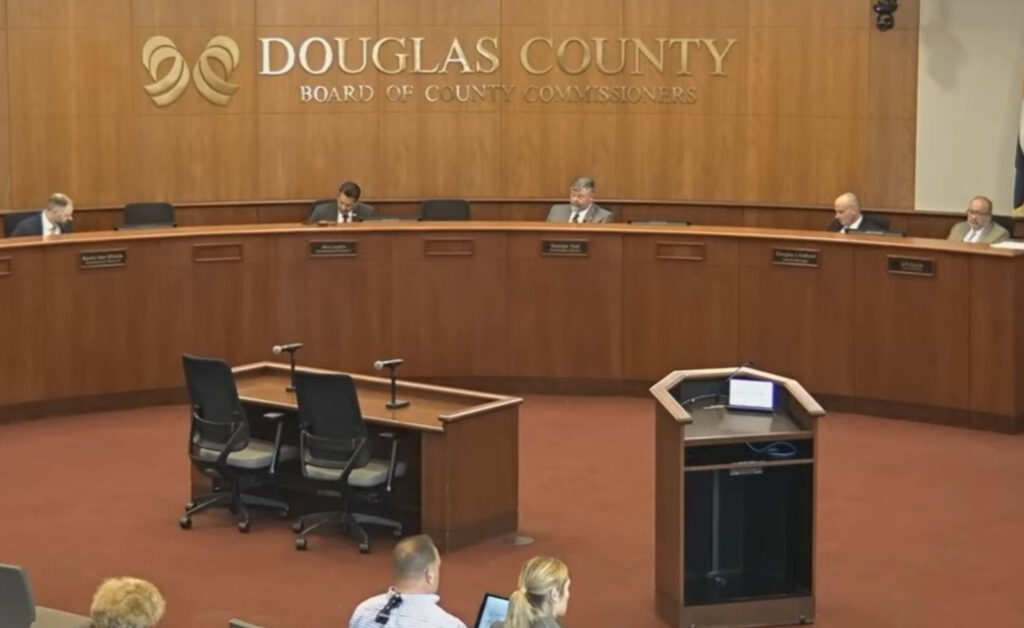
That hearing hasn’t happened. Instead, the three commissioners submitted a certiorari petition to the Supreme Court on Monday, asserting that the plaintiffs “presented no evidence of a prospective intent to violate COML or of any harm from purported future violations.” They also say the appellate court judges misinterpreted COML language applying the law to all meetings of a quorum “at which public business is discussed or at which any formal action may be taken.”
“The Division erroneously construed the italicized phrase to mean that ‘COML’s requirements are triggered not only when a meeting of a local public body is held, but also when such a meeting is contemplated,’” the commissioners’ petition claims. “Section 24-6-402(2)(b) fails to support this novel holding. The italicized phrase does not mean that COML’s applicability may be conclusively determined before the meeting even occurs.”
But the Court of Appeals’ ruling “contains no novel or unresolved issue of law,” argues a brief submitted to the Supreme Court on Tuesday by the plaintiffs, Democratic state Rep. Robert Marshall of Highlands Ranch, former Republican county commissioner Lora Thomas and unaffiliated voter Julie Gooden. The appellate judges “properly applied settled law in finding that (the commission) violated the open meetings law and is continuing to do so,” says the brief, drafted by attorney and Colorado Freedom of Information Coalition president Steve Zansberg.
Zansberg urged the justices to “fast-track” its review of the commissioners’ petition, arguing that the lack of an injunction against the commissioners means they could “continue denying the public its statutory rights to observe ‘the formation of public policy.’” But the Supreme Court denied that motion on Wednesday.
The Court of Appeals panel found that the commissioners violated the sunshine law by failing to strictly comply with the statutory requirements for convening executive sessions. It also determined that 11 unnoticed “advanced planned meetings” to discuss issues including immigration and a proposed home rule charter “clearly concerned public business or policymaking.”
A district court judge’s conclusion that none of these meetings were ‘a part of the policy-making process’ is clearly erroneous,” wrote Judge Daniel Taubman in the opinion.
For a meeting to be subject to the open meetings law, there must be a demonstrated link between the content of the meeting and the policymaking responsibilities of the public body, the Colorado Supreme Court decided in Board of County Commissioners of Costilla County v. Costilla County Conservancy District in 2004. “Such a link exists,” that ruling says, “when the meeting is convened to discuss or undertake one of the actions enumerated in the remedy provision of the [open meetings law] such as a rule, regulation, ordinance, or formal action.”
The commissioners’ resolutions about the home rule charter vote and immigration “fell squarely” under what the Supreme Court ruling considers to be public business, the Court of Appeals determined.
The commissioners’ certiorari petition claims that no policies or resolutions were “substantively discussed” at their advance planning meetings, “only administrative matters, including scheduling issues and media planning.”
The Court of Appeals opinion “manufactures a COML violation from premeeting agendas —elevating what could be discussed over what was discussed,” it says.
Follow the Colorado Freedom of Information Coalition on X and Bluesky. Like CFOIC’s Facebook page. Do you appreciate the information and resources provided by CFOIC? Please consider making a tax-deductible donation.