
By Jeffrey A. Roberts
CFOIC Executive Director
The Colorado Court of Appeals will decide whether a town council’s improperly noticed meeting requires the public disclosure of an executive session recording.
The Georgetown Board of Selectmen is seeking the reversal of a judge’s ruling last year that it violated the Colorado Open Meetings Law with an Aug. 19, 2024, agenda that listed only an unspecified “executive session.” The board came out of the executive session and voted to appoint a new police chief.
The board did not provide “fair notice to the public,” Clear Creek County District Court Judge Catherine Cheroutes found in August 2025. She barred board members from making further violations of the COML’s notice requirement and ordered them to release the entire executive session recording to plaintiffs Kerry Ann McHugh and Jon Gaskins.
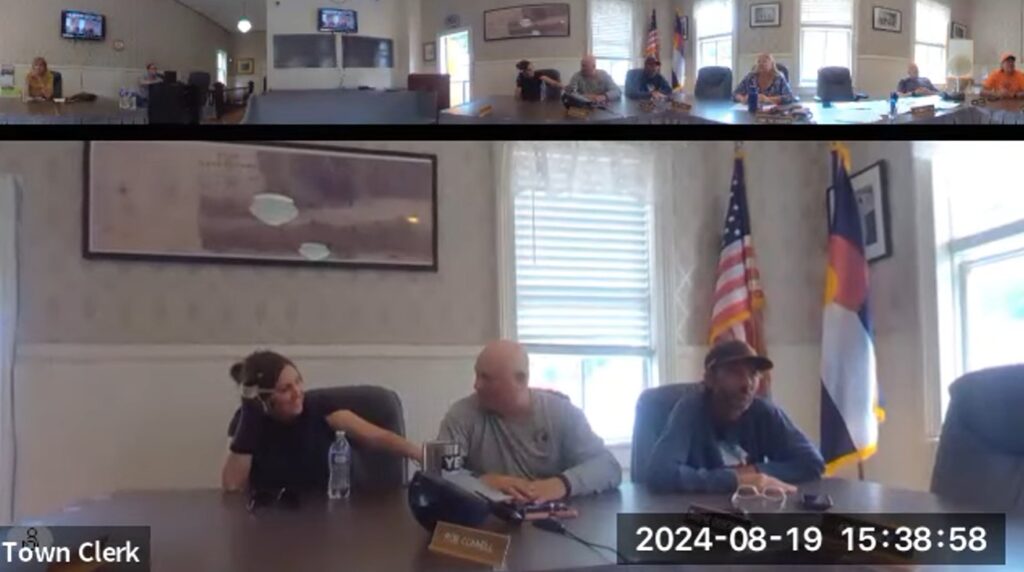
McHugh is a former Georgetown police judge, equivalent to a mayor, and Gaskins was the town’s acting marshal. (Georgetown still operates under a territorial charter, and its governing body is the board of selectmen.)
The open meetings law requires local public bodies such as the selectmen to provide “full and timely” notice of meetings, with “specific agenda information where possible,” at least 24 hours ahead of time. A notice is sufficient if the items actually considered at the meeting are “reasonably related” to the subject matter indicated by the notice,” the Colorado Supreme Court decided in 2008.
“In determining whether the notice at issue is ‘full,’ we apply an objective standard, meaning that a notice should be interpreted in light of the knowledge of an ordinary member of the community to whom it is directed,” the Supreme Court wrote in Town of Marble v. Darien.
The selectmen argue in an appellate brief that “an ordinary citizen of Georgetown would have known that the entire purpose of the August 19 special meeting was to discuss the search for a Police Chief.” At the board’s meeting three days before and in an initial notice for the August 19 meeting, “the public was informed that this would be the topic of the special meeting,” the brief says. “The amended notice, in this context, is most reasonably read to clarify that this discussion about hiring a Police Chief would take place in executive session.”
But “prior minutes, notices, business or notoriety do not operate to insert a topic into a topic-less agenda,” McHugh and Gaskins contend in a brief submitted by attorney Eric Maxfield, a board member of the Colorado Freedom of Information Coalition. “Moreover, an individual who has such knowledge is not ordinary, but extraordinary. Thus, under Marble the notice was not ‘full.’”
The town’s brief, prepared by attorney Geoffrey Klingsporn, notes the selectmen “properly announced” the August 19 executive session — “to instruct negotiators and receive legal advice on and for a personnel matter: filling Town Police Chief vacancy” — at the time it was convened. “This is all the statute requires to announce an executive session,” it says.
McHugh and Gaskins, however, contend that “an executive session cannot be properly convened in a meeting noticed without identifying any subject to be addressed.” Because deleting the police chief topic from the agenda “effectively deprived the public of an opportunity to attend by chasing away those interested in the police chief item … the Board announced the reasons for convening the executive session to an empty room.”
The recording of the executive session must be released, Maxfield wrote, under the Court of Appeals 2004 ruling in Gumina v. Sterling: “[I]f a local public body fails strictly to comply with the requirements set forth to convene an executive session, it may not avail itself of the protections afforded by the executive session exception.”
During oral arguments Sept. 23, Maxfield told a three-judge Court of Appeals panel an executive session isn’t permitted during a meeting that wasn’t adequately noticed. “In order to have a proper meeting, one must have full notice, and notice of no topic cannot get you there,” he said.
Appellate Judge Craig Welling said a meeting notice is a “different issue” from whether an executive session is properly convened. “As long as you have a proper announcement of the executive session at even an improperly noticed meeting, your actions at the improperly noticed meeting may be void, but the executive session isn’t subject to full disclosure unless there is a defect in the announcement or the substance.”
Both parties agreed that the question of whether an improperly noticed meeting requires disclosure of an executive session recording is an issue of first impression, meaning there is no court precedent to follow.
Follow the Colorado Freedom of Information Coalition on X and Bluesky. Like CFOIC’s Facebook page. Do you appreciate the information and resources provided by CFOIC? Please consider making a tax-deductible donation.