By Jeffrey A. Roberts
CFOIC Executive Director
In the 54 years since a voter-approved ballot initiative established the Colorado Open Meetings Law within the Sunshine Act of 1972, state lawmakers have amended the statute several times.
A major overhaul in 1991 expanded its scope, making local public bodies like city councils and school boards subject to the law and defining a “meeting” to be “any kind of gathering, convened to discuss public business,” whether it’s in person, by telephone or by another means of communication. A 2001 revision requires a public body to publicly announce the topic of an executive session before closing the door.
A 2021 amendment clarifies that elected board members may exchange scheduling emails and other messages that do not concern the “merits and substance” of public business. Two years ago, the legislature exempted itself from major portions of the open meetings law.
Below are some ideas for additional changes that favor government transparency and the notion that governmental proceedings could be made more accessible to more people without imposing unreasonable burdens on public bodies. These proposed updates are gleaned from the more than 7,600 inquiries to the Colorado Freedom of Information Coalition’s FOI hotline over the past 13 years.
Post meeting notices online. The open meetings law still allows government boards, councils and commissions to post meeting notices in a formally designated physical place like on a wall at a town hall. A 2019 amendment makes local public bodies compliant with the law if they post meeting notices on a website, but doing so is optional.
This seven-year-old provision says, “It is the intent of the general assembly to closely monitor the transition to providing notices of public meetings online over the next two years and, if significant progress is not made, to bring legislation mandating in statute that all notices be posted online except in very narrow circumstances that are beyond the control of a local government.”
But no such legislation has been brought.
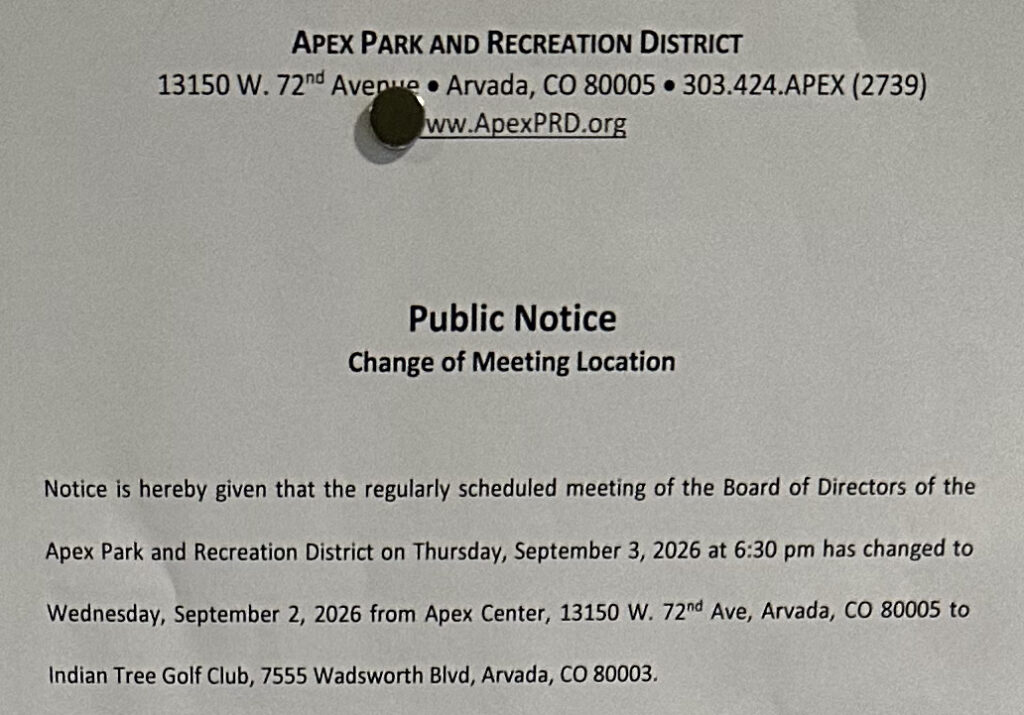
The Apex Park and Recreation District board in Arvada changed the date and location of its scheduled September 3 meeting without posting any notice on its website or on social media. Instead, it tacked paper notices and agendas — discussion items included a board member’s resignation and the appointment of a new board member — on walls at the Apex Center and two other district facilities.
“Historically, posting meeting notices or changes to our website and social media channels has not been a customary practice for Apex Park and Recreation District,” Hillary Roemersberger, Apex’s director recreation services, told CFOIC in an email. “Our longstanding process has been to post notices in accordance with the requirements of the Colorado Open Meetings Law, including notices at our designated posting locations.”
“That said,” she added, “we recognize that communicating meeting information through additional channels can improve accessibility and awareness for our community … Moving forward, we anticipate making greater use of our website and social media platforms as part of those efforts.”
The 2019 bill language also encourages local governments that don’t have websites to use free resources for creating them offered by the Colorado Statewide Internet Portal Authority.
Electronically record all open meetings. The open meetings law requires public bodies to “electronically record the minutes” of their open meetings if they started doing so on or after Aug. 8, 2001. Does this awkward language mean that public bodies must audio record all their meetings? Does it mean they must audio record only those meetings at which minutes are required? Does it mean they don’t have to audio record meetings if they take handwritten minutes? (Does anyone take handwritten minutes anymore?)
Why not, in plain language, require public bodies to audio record all their open meetings? It is easy to do with a smartphone. If the recordings aren’t posted online, they could be requested under the Colorado Open Records Act.
Video livestream meetings. City councils, town boards, county commissions and other public bodies should video livestream their primary meetings on YouTube or another platform so that more people can observe and listen in real time. Past meetings should be archived online. Committees and subcommittees could be exempt from these requirements, although audio recordings should be made of those.
Many public bodies in Colorado already video livestream their primary meetings (doing so became commonplace during the COVID-19 pandemic), but CFOIC sometimes hears about those that do not. Most recently, for example, Adams County School District 14 in Commerce City.
The Denver-based Open Media Foundation, which produces video coverage of Colorado House and Senate floor proceedings, helps local governments present their meetings online. Early in the pandemic, the nonprofit provided its services to governments for free.
Let people record and stream meetings themselves. Alabama law lets anyone video or audio record meetings of governmental bodies, except executive sessions, “provided the recording does not disrupt the conduct of the meeting.” A governmental body may adopt “reasonable” rules for recording.
That is essentially what case law says about letting the public record public meetings. Why not make it explicit in the statutes so there is no confusion, especially for public bodies that do not record or livestream their meetings themselves.
Post meeting packets online. Many public bodies already do this, making it convenient for observers to review documents that are discussed during open meetings. But some force people to make CORA requests for meeting-packet materials, charging fees and making them wait three working days.
Meeting materials already prepared for board members are “readily available” and should be provided when requested if they aren’t posted online. The three-working-day production deadline in CORA is for records that are “not readily available.” (Also, a government cannot claim that materials “produced and distributed to the members of a public body for their use or consideration in a public meeting” are confidential work product.)
In 2025, the legislature required the Public Employees’ Retirement Association board to post on its website meeting notices as well as “any available presentations and other documents that might be considered at the next public meeting of the board” and the records of prior board meetings.
Similar statutory language could be applied to other public bodies.
Post minutes online. Local public bodies must keep and promptly record minutes of meetings where the adoption of any policy or other formal action occurs or could occur, but there is no requirement that minutes be posted online, except for school boards.
A separate statute requires school boards to post on a website, or otherwise publish, minutes of meetings that included executive sessions, indicating “the topic of the discussion at the executive session as well as the amount of time each topic was discussed while the board was meeting in executive session.”
Many public bodies post their minutes online. For those that don’t, why make people submit CORA requests for meeting minutes?
Follow the Colorado Freedom of Information Coalition on X and Bluesky. Like CFOIC’s Facebook page. Do you appreciate the information and resources provided by CFOIC? Please consider making a tax-deductible donation.