
By Jeffrey A. Roberts
CFOIC Executive Director
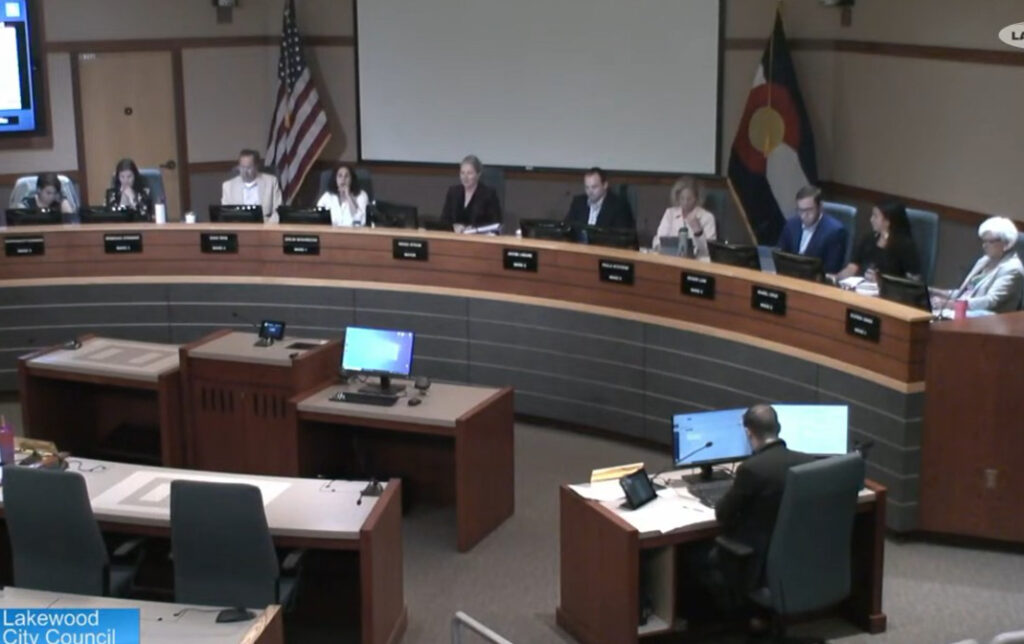
The Lakewood City Council violated the Colorado Open Meetings Law by failing to publicly announce the topic of a 2024 executive session “in as much detail as required,” a judge ruled Friday.
Lenore Herskovitz’s lawsuit against the city was related to a zoning ordinance dispute between Lakewood and Colorado Christian University over university-owned residential property. Councilmembers convened an Aug. 26, 2024, closed-door meeting by stating they would receive legal advice “regarding legal issues and concerns arising out of” the CCU litigation, which the Colorado Court of Appeals had decided in the city’s favor.
But while the council noted the appellate case number in the announcement, “it did not specify which legal issue or concern arising from that litigation the Council intended to discuss,” Jefferson County District Court Judge Andrew Poland wrote.
“The Council could have provided additional information about the subject of the legal advice while preserving the confidentiality of the advice itself,” Poland concluded. “For example, it could have identified the legal issue as involving enforcement of the zoning ordinance, the continuing legal effect of the appellate decision, potential land-use implications, or any other discrete legal question the Council intended to address, without disclosing counsel’s analysis, recommendations, or conclusions.”
Between the November 2023 Court of Appeals opinion and the August 2024 executive session, enforcement of the zoning ordinance continued to be controversial. “For months after the COA opinion,” Herskovitz’s original complaint says, “the public attempted to persuade the City to enforce the prohibition that was won on appeal. The City did not. The City instead suggested the ordinance be changed, but the public could not see for what purpose.”
Robert Huss, senior assistant city attorney for Lakewood, defended the sufficiency of the August 2024 executive session announcement in court filings, saying the city “identified the subject and the nature of the privileged communication, specifically the CCU v. Lakewood matter. More information was not required, and further information could have waived the privilege, thereby compromising the purpose of the executive session — providing the Council with the requested legal advice.”
“Discussing the application of cases and law, be it to strategize in an active case or referencing and applying a resolved case to advise clients, is what attorneys do and why legal advice is discussed and privileged in executive session,” Huss wrote in a motion to dismiss the lawsuit.
But Herskovitz testified during a trial last March that “she did not understand from the announcement which issue the Council intended to discuss and was therefore unable to prepare public comment on that issue,” the judge’s ruling says. “The Court does not treat Ms. Herskovitz’s subjective understanding as dispositive of whether COML was violated. Her testimony, however, illustrates the limited information conveyed by the announcement.”
Before voting to convene an executive session, the open meetings law requires a public body — during the public portion of a meeting — to identify “the particular matter to be discussed in as much detail as possible without compromising the purpose for which the executive session is authorized.”
In a 2020 opinion, Guy v. Whitsitt, the Court of Appeals determined that it was possible for the Basalt town council “to describe at least the ‘subject matter’ of what was to be discussed” during an executive session convened for legal advice “without waiving the attorney-client privilege.”
In the Lakewood case, Poland wrote, the relevant question is “not simply whether the public could identify the litigation generally associated with the executive session, but whether the Council identified the particular legal matter underlying that litigation with as much specificity as reasonably possible.”
While Poland’s ruling declares that the Lakewood City Council violated the open meetings law, he did not issue an injunction against the city. Poland wrote that he could not order the release of an executive session recording because “none was made.” (Executive sessions must be electronically recorded, except for portions that constitute privileged attorney-client communications.)
Herskovitz is entitled to an award of court costs and reasonable attorney fees in an amount to be determined, the judge’s order says. Herskovitz is represented by attorney Anita Springsteen, a former Lakewood councilmember.
Follow the Colorado Freedom of Information Coalition on X and Bluesky. Like CFOIC’s Facebook page. Do you appreciate the information and resources provided by CFOIC? Please consider making a tax-deductible donation.