By Jeffrey A. Roberts
CFOIC Executive Director
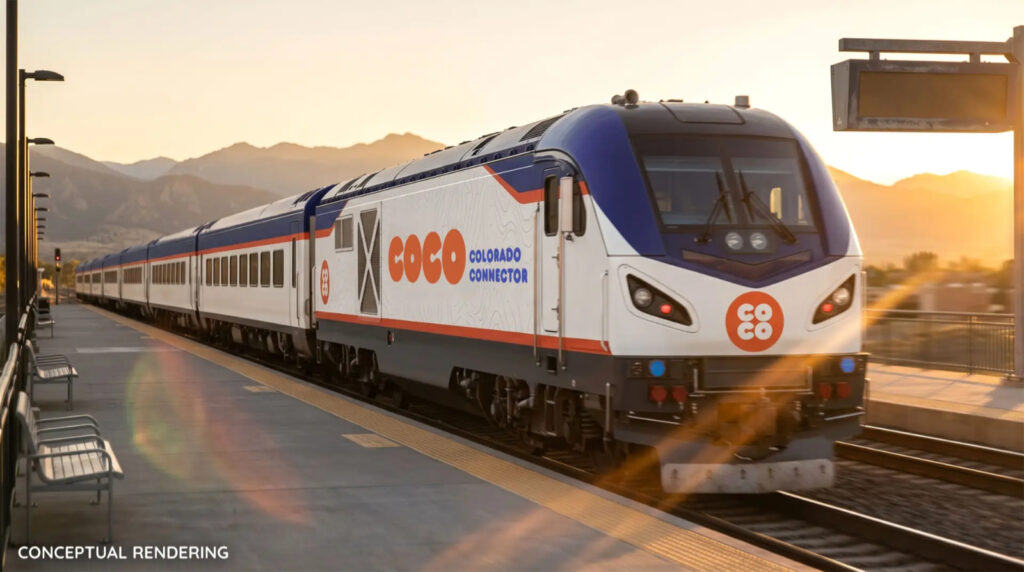
The agency planning the Colorado Connector (CoCo) passenger train will change its CORA fees policy to conform with the statute in response to questions raised by the Colorado Freedom of Information Coalition.
Under the Colorado Open Records Act, government entities are allowed to charge no more than $41.37 an hour, after an initial free hour, to process requests.
But a 2023 policy adopted by the Front Range Passenger Rail District says requesters will be assessed the hourly rate of a contractor, attorney or salaried district staff member for “requests that require more than mere retrieval of records, such as reformatting data collected in a form not easily disclosable, applying unique suppression rules to remove identifiability and/or legal expertise to determine how to comply with confidentiality rules.”
The review and possible redaction of records before they are released are routine parts of the research-and-retrieval process, and a separate rate for “legal expertise” or to “comply with confidentiality rules” is not authorized in the state statute.
In 2013, the Colorado Court of Appeals ruled that a government “may charge a reasonable fee ($25 an hour) for retrieving and researching records, including the time it takes to identify and segregate records that need not be disclosed.” That included the creation of a privilege log. In 2014, the legislature codified a maximum $30 an hour rate (after the first hour) with that rate — now $41.37 an hour — to be adjusted for inflation every five years.
“The CoCo policy conflicts with the express provisions of CORA, as interpreted by the courts, and is therefore unenforceable,” said media and freedom-of-information attorney Steve Zansberg, CFOIC’s president.
CFOIC became aware of the rail district’s CORA fee policy earlier this month after taxpayer advocate Natalie Menten requested receipts, contracts and payment records related to the Colorado Connector. The district quoted Menten a $586 fee and told her, “As the District has a very small staff and relies heavily on outside consultants, these are costs that accrue directly to the District and, as such, we will need to pass them on.”
Menten pushed back after conferring with CFOIC, which also contacted the district about the fee policy. In a follow-up email to Menten, the records custodian wrote, “In the public interest we are waiving all CORA fees for your request.”
“The policy has been taken down and is no longer applicable, and we’re going to be working on drafting new policy,” district general manager Sal Pace told CFOIC on Thursday. “And we’re very thankful to you for reaching out and letting us know about it. The policy was drafted by previous legal counsel, and we changed legal counsel about 10 days ago.”
Brent Butzin, the district’s attorney and elections official, resigned Oct. 12 after the district announced that ballots sent to 800,000 voters erroneously included a Nov. 3 sales tax question. The Front Range Passenger Rail District is proposing a 0.333% sales tax to fund the southern portion of the Colorado Connector, which is designed to ultimately provide daily passenger service to 12 communities between Fort Collins and Pueblo. The first phase, between Fort Collins and Denver, is expected to begin operating in 2029.
In a statement emailed to CFOIC, district spokeswoman Tara Trujillo said a staff member gave Menten “a good faith but incorrect quote. To date the District has never charged anyone for a CORA request.”
“There weren’t a lot of requests coming until recently,” Pace said. “All of a sudden, there’s a lot more interest.” He told CFOIC the board will meet in the coming months to write “a policy that makes more sense.”
Under CORA, the district cannot charge fees to process records requests until a new fees policy is published.
Follow the Colorado Freedom of Information Coalition on X and Bluesky. Like CFOIC’s Facebook page. Do you appreciate the information and resources provided by CFOIC? Please consider making a tax-deductible donation.