By Jeffrey A. Roberts
CFOIC Executive Director
Lawyers for Boulder and Yellow Scene Magazine clashed in the Court of Appeals over whether Colorado’s Law Enforcement Integrity Act lets agencies charge hundreds or thousands of dollars to provide body-worn camera footage showing possible misconduct by police officers.
A three-judge appellate panel heard their arguments Tuesday in front of an audience of students at Colorado State University as part of the judicial branch’s Courts in the Community program.
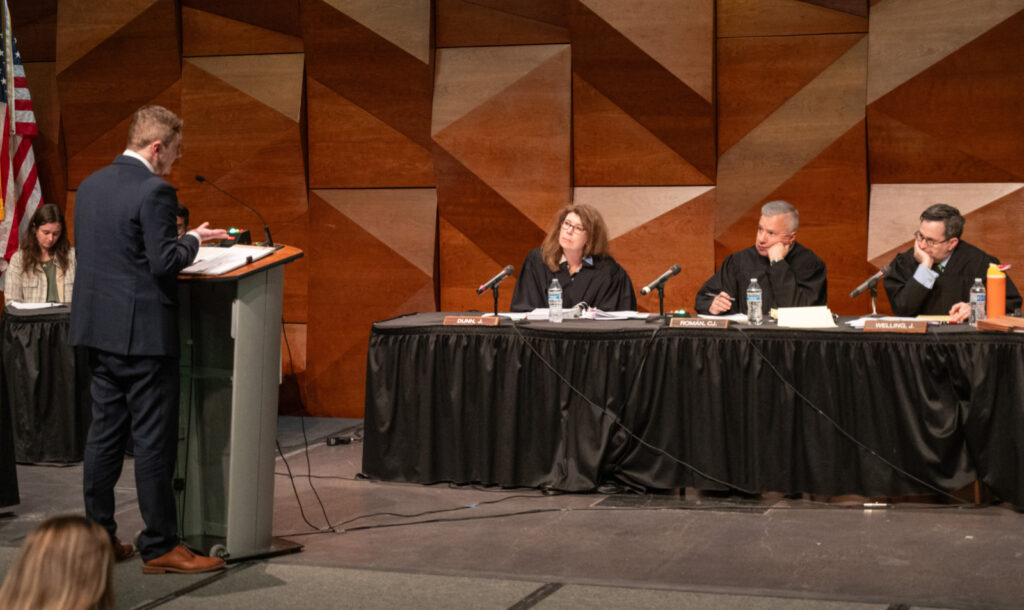
“This case is not about whether videos are subject to disclosure. There is no dispute that these videos are subject to disclosure,” said Luis Toro, senior counsel for the city of Boulder. “… This case is about money. It’s about the cost of the extensive video blurring required by the statute.”
Matt Simonsen, an attorney for Yellow Scene, summarized the disputed issue from the perspective of the records requester: “Can that footage be hidden indefinitely behind a several-thousand-dollar paywall?”
The answer is no, he said. “The law’s explicit requirement to release this footage simply does not depend on payment.”
In the underlying lawsuit, a Boulder County District Court judge ruled in 2024 that the Boulder police department cannot make Yellow Scene pay the city $2,857.50 to obtain video of officers shooting and killing 51-year-old Jeanette Alatorre in 2023. The judge found that the “plain language” of the Law Enforcement Integrity Act (also known as the Integrity Act, Senate Bill 20-217, the Enhance Law Enforcement Integrity Act or ELEIA) does not allow the charging of fees for the mandatory release of footage of certain footage.
Under the statute, all unedited video and audio recordings of incidents “in which there is a complaint of peace officer misconduct … through notice to the law enforcement agency involved in the alleged misconduct” must be released to the public no later than 21 days after a request is made. An agency can delay the release of video until 45 days from the date of an allegation of misconduct if the video “would substantially interfere with or jeopardize an active or ongoing investigation.”
Boulder appealed the district court ruling, contending that the judge ignored the fact that the bodycam footage is still a criminal justice record and, therefore, the fee provision in the Colorado Criminal Justice Records Act (CCJRA) applies if blurring is necessary (allowed under the Integrity Act if a video “raises substantial privacy concerns”). A brief submitted by the Colorado Municipal League, Colorado Counties Inc. and the County Sheriffs of Colorado contended that the judge’s interpretation of the law “would significantly fiscally burden and create an unfunded mandate on local governments.”
Noting that the Integrity Act doesn’t include a fee provision, Judge Gilbert Román asked Toro “why wouldn’t one come to the conclusion that it was not the intent of the General Assembly to require parties to have to pay fees to get access to these videos?”
Similarly, Judge Stephanie Dunn pointed out that the disclosure of most records under the CCJRA is discretionary while records subject to the Integrity Act must be released if requested. If legislators “wanted to condition compliance under the Integrity Act, why didn’t they just add a fee provision? It would be easy to do,” she said.
Toro said the Integrity Act and the CCJRA “need to be read together.” State lawmakers, he argued, “anticipated that the CCRJA’s fee provisions would apply” to the Integrity Act.
Simonsen said lawmakers amended the CCJRA in 2008 to clarify that “the fees are only available when a criminal justice record is requested pursuant to” the CCJRA — a provision highlighted by the district court judge in his ruling against Boulder.
The General Assembly passed the Integrity Act in 2020 — and amended it in 2021 —following the police killings of George Floyd in Minneapolis and Elijah McClain in Aurora. The law includes several other provisions such as a requirement that law enforcement officers wear body-worn cameras. The legislature “was being bold and it was being purposeful when it set (the Integrity Act) out on its own” in the statutes, Simonsen told the judges.
The judges asked Simonsen about Boulder’s argument that not allowing fees for footage under the Integrity Act would go against a 1991 law that makes state mandates optional unless the state reimburses local governments for their costs.
“Boulder has said this is unfunded, but they’ve never been able to tell us how much it costs,” Simonsen said. “… There’s been no claim that additional employees need to be hired for this. And I would certainly hope that when there is a complaint of police misconduct that there are public employees reviewing this video for other purposes than just to blur it.”
Boulder’s data shows that police responded to more than 73,000 calls in 2024 and received seven complaints of serious officer misconduct, he told the judges. Total complaints related to fewer than 100 incidents.
Toro said the unfunded mandate is a “question of statutory construction. You can tell that there were no funds allocated for the ongoing expenses of producing blurred video forever because the only funding” was a program to help agencies purchase body-worn cameras.
The Colorado Freedom of Information Coalition and the American Civil Liberties Union of Colorado submitted an amicus brief last July asking the Court of Appeals to affirm the district court’s ruling.
Follow the Colorado Freedom of Information Coalition on X and Bluesky. Like CFOIC’s Facebook page. Do you appreciate the information and resources provided by CFOIC? Please consider making a tax-deductible donation.