Senate passes CORA fees bill, adds amendment to charge all requesters equally
A bill that caps research-and-retrieval fees for public records at $30 per hour passed the Colorado Senate with an amendment requiring that costs be the same for everyone.
A revised version of the mug shot bill won initial approval in the Colorado Senate, while state senators also gave a preliminary nod to amended legislation on open-records fees.
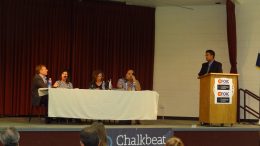
In recognition of national Sunshine Week, CFOIC and KUSA-TV hosted a panel for citizens and journalists on access to public records. Moderator Kyle Clark led panelists Melissa Blasius, Joel Dyer, Keli Rabon and Steve Zansberg through a lively discussion. View the entire presentation on our blog.
The passive surveillance bill is close to being on its way to Gov. John Hickenlooper’s desk. The measure, which mandates the purging of most images captured by government cameras after three years, won unanimous approval in the Colorado Senate.
An amendment to HB 14-1193 removes the minimum wage requirement and instead caps research and retrieval fees at $30 per hour with a requirement that the first hour be provided for free.
The trick to getting records from Colorado’s health exchange is to make relatively narrow requests. If the request is just right, officials must supply the information within three business days.
An amendment to be proposed caps the hourly rate at $25 for researching and compiling public records, with the maximum rate adjusted for inflation every five years. More significantly, the first two hours would be free.
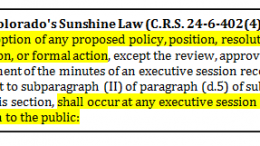
A controversial bill to require the electronic recording of all portions of school board executive sessions was killed in a Senate committee at the request of the sponsor.
In a victory for public access to court records, an Arapahoe County judge ordered the unsealing of transcripts in the case against death-row inmate Sir Mario Owens.
A possible amendment to a controversial bill on school board executive sessions would weaken a key provision of the proposal which mandates the electronic recording of portions of closed-door meetings that currently aren’t recorded because attorney-client privilege has been claimed.