Update: Proponents filed a revised version of the proposed constitutional ballot initiative on Monday, March 2.
By Jeffrey A. Roberts
CFOIC Executive Director
An initiative for the fall ballot filed Friday by the leaders of the Independence Institute and the League of Women Voters of Colorado would enshrine in the Colorado Constitution “a fundamental right to know the affairs of all levels of state and local government.”
The transparency proposal is the product of several months’ work by a diverse alliance of groups that also includes the Colorado Freedom of Information Coalition, Colorado Common Cause, the Colorado Broadcasters Association, the Colorado Press Association and the American Civil Liberties Union of Colorado.
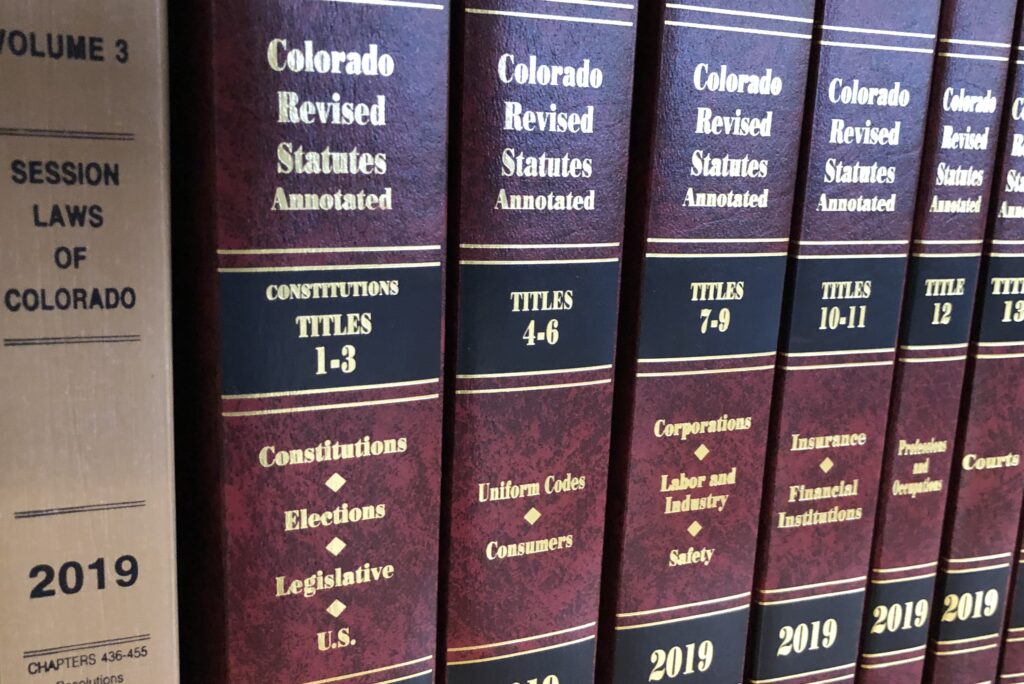
If it makes the statewide ballot and wins approval from voters, Colorado would be one of at least nine states with a constitutions that expressly mention the right to inspect government documents or attend government meetings, or both.
“A healthy democracy requires informed understanding and public participation in government decision-making. The League of Women Voters of Colorado believes that the people’s right to know is fundamental in a government of, by and for the people,” said Beth Hendrix, the organization’s executive director, in an emailed statement to CFOIC.
“The most amazing part of this process has been the incredibly diverse group of organizations and activists who are demanding the right to know what goes on in government,” co-proponent Jon Caldara, president of the libertarian Independence Institute, told CFOIC. “Groups that have been pitted against each other on every conceivable political issue agree on one thing — government in Colorado is becoming dramatically more opaque, and democracy cannot last when those in power work in the dark.”
The proposal amends Article II of the state constitution — the Bill of Rights. It declares that “because all political power is vested in and derived from the people, and by right all government originates from the people … the people have a fundamental right to know the affairs of all levels of state and local government.” And because the General Assembly and other governing bodies and officials in Colorado “have increasingly infringed on the fundamental right to know,” access to public proceedings and public records must be guaranteed.
“No person shall be denied or deprived or unreasonably burdened in the exercise of the fundamental right to know the affairs of all levels of state and local government,” it adds. To close a meeting of a public body or withhold from disclosure all or part of a public record, a government “must demonstrate, by clear and convincing evidence, that such meeting or information is exempt.”
The proposed constitutional amendment includes sanctions: Any public official, officer, employee or agent of government who knowingly violates the provisions would be subject to a civil penalty of at least $1,000 for each violation.
Fortifying the right to know in a state constitution can serve two purposes: 1) giving weight to public access when legal disputes arise and 2) possibly constraining legislators who might want to dilute the open-government statutes.
In 2024, the legislature exempted itself from portions of the Colorado Open Meetings Law, which the voters of Colorado enacted in 1972. State lawmakers are trying in 2026, for the third consecutive year, to give government entities up to three calendar weeks to fulfill many Colorado Open Records Act requests.
Adding the right to know to Article II as a “fundamental right” — like free speech and a free press — gives it more weight because fundamental rights have a higher degree of protection from government interference.
“This degree of protection would ensure public records laws would be fully interpreted with a presumption toward disclosure, and any governmental action which would potentially limit disclosure would be required to be ‘necessary’ and also relate to a ‘compelling governmental purpose,’” wrote Pennsylvania State University law professor Chad Marzen in a 2020 Public Interest Law Journal paper that argued for both federal- and state-level right-to-know constitutional amendments.
The process for getting an initiative on a statewide ballot is spelled out on the General Assembly’s website. The text must first be submitted to the Legislative Council staff for review and comments by Legislative Council and the Office of Legislative Legal Services. Then a proposal goes to the Secretary of State for ballot title-setting by the Title Board, which determines whether a proposal contains a required single subject.
Signature gathering can begin once the ballot title and petition form are approved.
“To be placed on the ballot,” the legislature’s website says, “the signature requirement is at least five percent of the total votes cast for all candidates for the Office of Secretary of State at the previous general election. In addition to this signature requirement, a proposal that seeks to make a change to the Colorado Constitution requires signatures of at least 2 percent of the total registered electors in each of the 35 Colorado state senate districts.”
Follow the Colorado Freedom of Information Coalition on X and Bluesky. Like CFOIC’s Facebook page. Do you appreciate the information and resources provided by CFOIC? Please consider making a tax-deductible donation.