By Jeffrey A. Roberts
CFOIC Executive Director
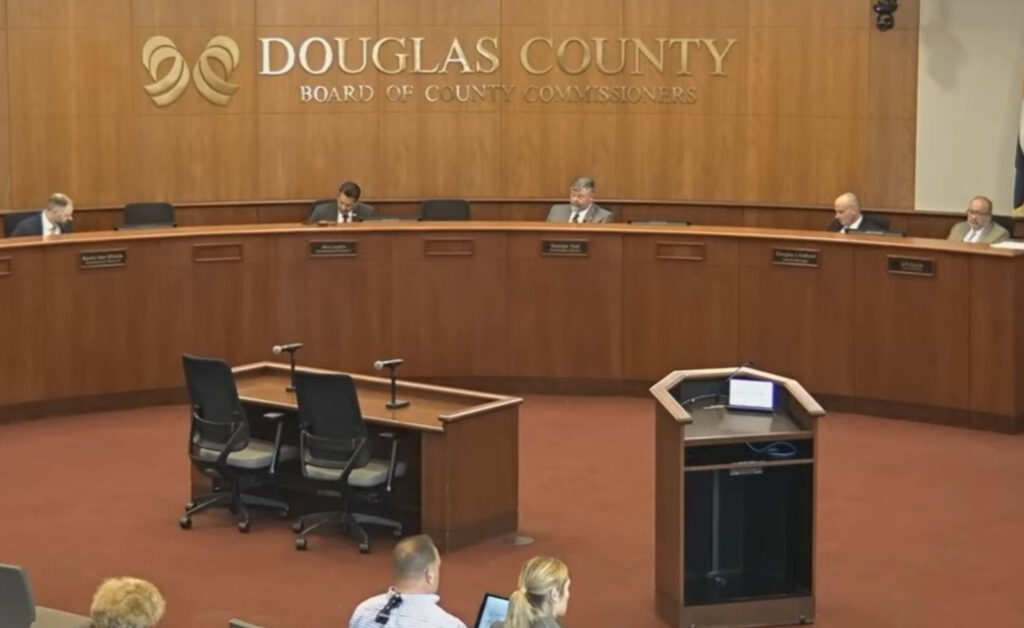
A judge last May wrongly decided that the Colorado Open Meetings Law did not apply to several Douglas County Commission meetings held outside of public view, the Colorado Court of Appeals ruled Thursday.
A three-judge appellate panel found that the commissioners violated the sunshine law by failing to strictly comply with the statutory requirements for convening executive sessions. It also determined that 11 unnoticed “advanced planned meetings” to discuss issues including immigration and a proposed home rule charter “clearly concerned public business or policymaking.”
“[T]he court’s conclusion that none of these meetings were ‘a part of the policy-making process’ is clearly erroneous,” wrote Judge Daniel Taubman in an unpublished opinion.
The Court of Appeals ordered the case sent back to the district court for further proceedings “consistent with this opinion,” including “a hearing to determine if the BOCC [board of county commissioners] has continued to violate” the open meetings law.
The lawsuit against the commissioners was filed by three residents, Democratic state Rep. Robert Marshall of Highlands Ranch, former Republican county commissioner Lora Thomas and unaffiliated voter Julie Gooden. In denying their motion for a preliminary injunction on May 20, 2025, Douglas County District Court Judge Robert Lung decided they were “not reasonably likely to succeed on the merits” of their open meetings case, which would have halted an ultimately unsuccessful June 2025 special election to make Douglas County a home rule county.
Lung concluded the advanced planning meetings “were limited to day-to-day direction to staff.”
But the residents, represented by attorney and Colorado Freedom of Information Coalition president Steve Zansberg, argued there was “undisputed evidence” the commissioners discussed the home rule initiative during the challenged meetings as well as whom to appoint to county boards and commissions, a resolution on immigration, the cost of conducting a formal survey of county residents and whether to change public comment rules.
For a meeting to be subject to the open meetings law, there must be a demonstrated link between the content of the meeting and the policymaking responsibilities of the public body, the Colorado Supreme Court decided in Board of County Commissioners of Costilla County v. Costilla County Conservancy District in 2004. “Such a link exists,” that ruling says, “when the meeting is convened to discuss or undertake one of the actions enumerated in the remedy provision of the [open meetings law] such as a rule, regulation, ordinance, or formal action.”
The commissioners’ resolutions about the home rule charter vote and immigration “fell squarely” under what the Supreme Court ruling considers to be public business, the Court of Appeals determined.
“Therefore, meetings discussing these and other resolutions were subject to COML [the Colorado Open Meetings Law]; the trial court clearly erred by concluding otherwise,” Taubman wrote in the opinion.
The county commissioners, the three plaintiffs also alleged, met in executive session three times during luncheons in March 2025 without complying with the statutory requirements to convene an executive session. The open meetings law requires a public body to convene an executive session during the public portion of a regular or special meeting by announcing the “particular matter” to be discussed behind closed doors.
The district court judge found that “the resolutions were never discussed” during the executive sessions, that “no formal action regarding home rule was taken,” and that the attendees had “simply asked legal questions about the process.”
But “evidence cuts against the BOCC’s argument that there were no policy discussions or decisions made at these meetings,” the Court of Appeals concluded. The county attorney, it noted, testified that he answered “substantive” questions about the home rule charter and made a 20-slide PowerPoint presentation. Another witness testified that an executive session also concerned possible candidates for a home rule committee.
“Given the record evidence demonstrating that the executive sessions included extensive discussion about the home rule charter, we conclude the executive sessions were subject to COML,” the Court of Appeals opinion says.
Douglas County posted a statement on its website following the decision: “While the County disagrees with portions of the decision, because the Appeal was related to a preliminary injunction, it anticipated the matter would require further adjudication.”
“The County is currently weighing whether to return to the Trial Court, where it can present further evidence of its compliance with the law or request additional review by the Colorado Supreme Court,” it adds.
Follow the Colorado Freedom of Information Coalition on X and Bluesky. Like CFOIC’s Facebook page. Do you appreciate the information and resources provided by CFOIC? Please consider making a tax-deductible donation.