By Jeffrey A. Roberts
CFOIC Executive Director
A Colorado House bill would require municipal jails to maintain and make available to the public a daily record of inmates like county jails must do.
House Bill 26-1039, approved by state representatives Monday on a preliminary vote, primarily affects the Aurora Detention Center, also mandating that it comply with uniform statewide jail standards adopted by a commission created in 2022.
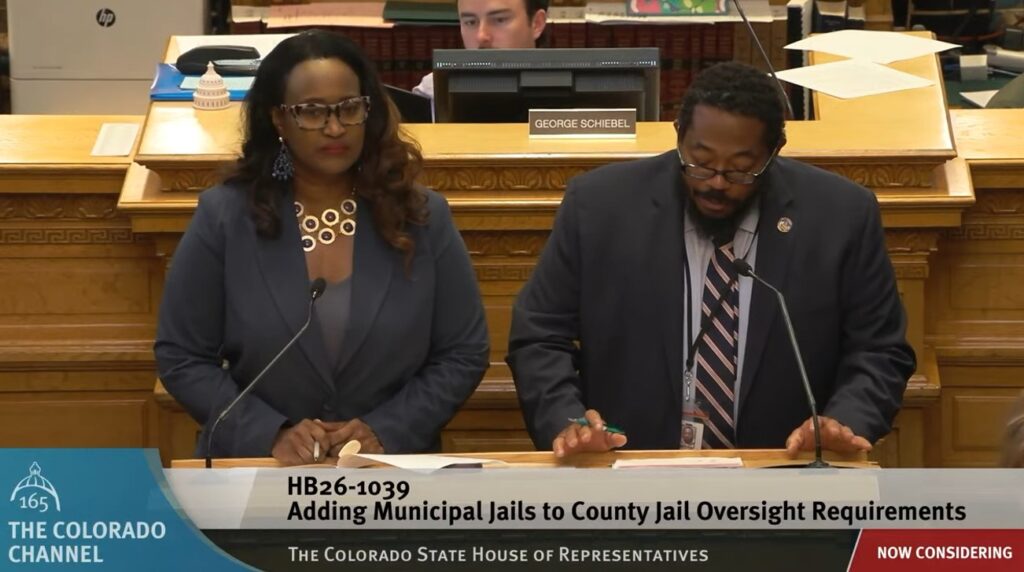
“If a facility is going to hold you post-conviction, there has to be a higher level of accountability for that facility,” said Rep. Michael Carter, who introduced the bill with Rep. Naquetta Ricks, during a committee hearing on the measure. Both are Aurora Democrats.
Among its provisions, the legislation adds city jails to the definition of jail facilities subject to the requirements of C.R.S. 17-26-118. That statute has long required county jails — and jails run by jurisdictions that are both cities and counties — to keep daily logs of information including: the name of each confined inmate; date of entrance; date of birth; race; ethnicity; gender; any criminal charges and the jurisdiction charging each offense; term of sentence, if sentenced; bond amount, if bond has been set; and release date.
In 2019, the General Assembly updated the law to require the reporting of considerably more information about jails, including: operational capacity; the number of confined inmates; the number of sentenced inmates; the number whose most serious charged offense is a felony; the number whose most serious charged offense is a misdemeanor; and the number held solely for a municipal offense.
The statute says the records “must be available to the public at all reasonable hours.” Each jail also must submit a quarterly report to the Colorado Division of Criminal Justice, which publishes an online dashboard.
Dave Perry, editor of the Aurora Sentinel, told the Colorado Freedom of Information Coalition that getting information from the Aurora jail has been challenging for him and his staff. Among the issues, there is no searchable database of inmates, no public information on possible bail and no way to determine whether inmates were previously held and then transferred to county jails.
“The facility can only keep inmates for 72 hours. Some city officials say only 24 hours. But some convicts in city court are sentenced for longer, apparently through ‘weekend jail’ sentences, but there is no readily available public record,” Perry added.
Dana Steiner, policy counsel for the Colorado Freedom Fund, told members of the House Judiciary Committee that her organization monitors municipal courts by watching proceedings, examining jail rosters and making records requests.
“Colorado has an unintentional gap in jail standards and transparency requirements that one municipal jail has fallen through,” she said, noting that the Aurora jail incarcerates about 60 people on a daily basis, an average higher than 20 of the state’s county jails.
“Jails should not become black holes where no one knows who is held there or what charges they’re held on,” Steiner told lawmakers. “Transparency is a tool for accountability. HB 26-1039 recognizes that wherever someone is detained in Colorado, transparency is called for.”
Follow the Colorado Freedom of Information Coalition on X and Bluesky. Like CFOIC’s Facebook page. Do you appreciate the information and resources provided by CFOIC? Please consider making a tax-deductible donation.