
By Jeffrey A. Roberts
CFOIC Executive Director
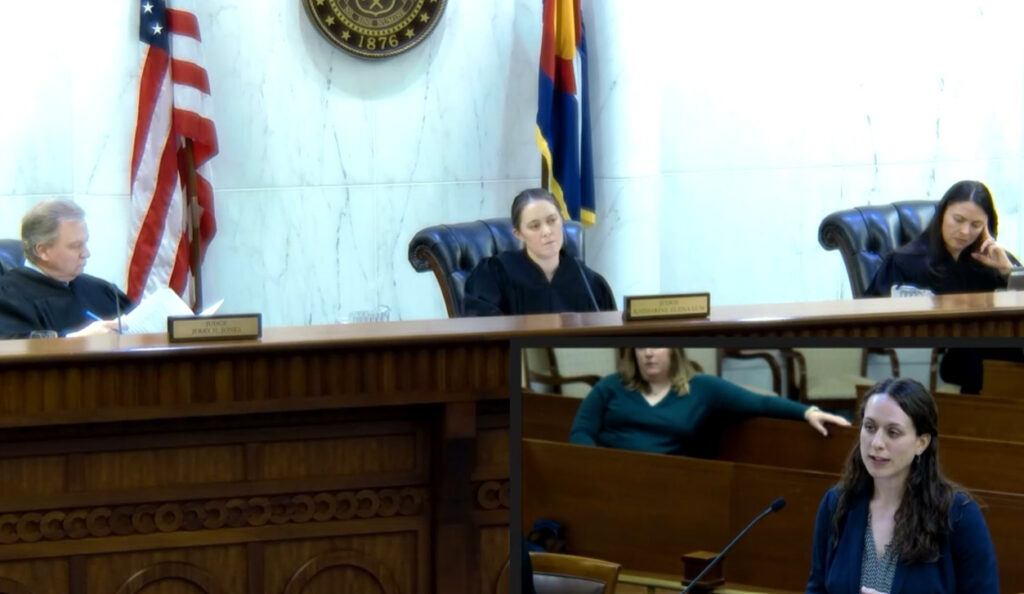
Lawyers for a prison inmate and the Office of the State Public Defender argued in the Court of Appeals this week over whether OSPD is subject to the Colorado Criminal Justice Records Act or the judicial branch’s records rules.
A three-judge appellate panel will determine whether Jefferson County District Court Judge Todd Vriesman correctly decided a year ago that Eric St. George is entitled to $13,650 in penalties from the agency for its “arbitrary and capricious” denial of his request for a policy document.
Vriesman ruled that the public defender’s regional office in Golden is covered by the CCJRA and abused its discretion under the statute by not providing St. George with its official policy regarding whether discovery files can be kept from clients held in pre-trial detention. St. George, who fired a shotgun at a Lakewood police officer in 2016 and is serving a 32-year sentence, asked for the record three times, according to a lawsuit he filed in 2023.
The definition of criminal justice records in the CCJRA encompasses “records that are made, maintained or kept in the state for use in the exercise of functions required or authorized by law,” said Madison Schaefer, St. George’s attorney, during oral arguments Wednesday. “OSPD’s function is to represent criminal defendants — indigent defendants. This policy, which implicates their client’s ability to participate in his own defense, is directly related.”
But Assistant Attorney General Sarah Quigley, representing OSPD in its appeal, contended that Vriesman “applied the wrong law” and that “P.A.I.R.R. 2 (Rule 2 – Public Access to Information and Records) exclusively governs the public defender’s administrative records.” P.A.I.R.R. 2, she added, does not include the assessment of penalties.
“The plain language of P.A.I.R.R. 2 says that it covers all administrative records of the judicial branch,” Quigley said.
When Quigley stated that the public defender’s office didn’t deny St. George’s request for the policy because he eventually received a copy, Court of Appeals Judge Katharine Lum asked, “Is that an argument the OSPD really wants to be making? … The OSPD asks for criminal justice records from criminal justice agencies. If we agreed with you, wouldn’t that mean a criminal justice agency could receive a request and do nothing with it and the OSPD would have no recourse?”
Quigley cited a 2025 Court of Appeals opinion that P.A.I.R.R. 2 “provides no cause of action when all responsive records have been made available for inspection, even if the production of those records was delayed.” While delay “isn’t ideal,” she told the appellate judges, “punitive penalties against the public defender because they never received notice or the request never went to the custodian is not appropriate.”
Schaefer cited the Court of Appeals’ 2023 opinion in Gazette v. Bourgerie, affirmed by the Colorado Supreme Court, that the Peace Officer Standards and Training board is criminal justice agency because it collects and stores arrest and criminal records as defined by the CCJRA.
“That was the deciding factor for the Court of Appeals,” said Schaefer, who is a board member of the Colorado Freedom of Information Coalition. “This court doesn’t have to look any further than the last clause of the statute to say that OSPD is clearly a criminal justice agency that maintains criminal justice records.”
Follow the Colorado Freedom of Information Coalition on X and Bluesky. Like CFOIC’s Facebook page. Do you appreciate the information and resources provided by CFOIC? Please consider making a tax-deductible donation.